Posts

Lenovo-YOGA-900

Image
Processor Up to 6 th  Generation Intel ®  Core™ i7 Processor Operating System Windows 10 Home Graphics Up to Intel® Iris™ Graphics 540 Memory Up to 16GB LPDDR3 1866 MHz (Onboard) Webcam 1MP 720p HD CMOS Camera Storage Up to 512GB PCIe SSD Audio JBL ®  Stereo Speakers with Dolby ®  DS 1.0 Home Theater ®  Certification Battery Local Video Playback Up to 9 hours playback with display brightness set at 200 nits WiFi Browsing Up to 10 hours browsing with display brightness set at 200 nits Display 13.3" QHD+ LED IPS Glossy Multi-touch (3200x1800) with integrated camera Dimensions (W x D x H) (inches) : 12.75" x 8.86" x 0.59" (mm) : 324 x 225 x 14.9 Weight Starting at 2.8 lbs (1.3 kg) WLAN WiFi 2 x 2 802.11 a/c, Bluetooth ®  4.0 Ports 2 x USB Type A 3.0 1 x USB Type C 3.0 with Video-out 1 x DC-in with USB 2.0 Function 4-in-1 Card Reader (SD, MMC, SDXC, SDHC) Audio Combo Jack
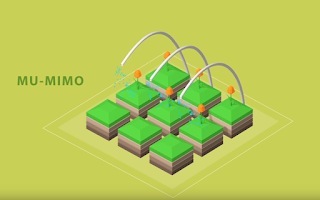
What is MU-MIMO Technology?

Image
Multi-User MIMO, multiple pipe water plant simultaneously.  Single-User MIMO, single pipe water plant. Multi-user MIMO (MU-MIMO) is a set of multiple-input and multiple-output technologies for wireless communication, in which a set of users or wireless terminals, each with one or more antennas, communicate with each other. In contrast, single-user MIMO considers a single multi-antenna transmitter communicating with a single multi-antenna receiver. In a similar way that OFDMA adds multiple access (multi-user) capabilities to OFDM, MU-MIMO adds multiple access (multi-user) capabilities to MIMO. MU-MIMO has been investigated since the beginning of research into multi-antenna communication, including work by Telatar on the capacity of the MU-MIMO uplink. SDMA massive MIMO coordinated multipoint (CoMP) and ad hoc MIMO are all related to MU-MIMO; each of those technologies often leverage spatial degrees of freedom to separate users. Recource from  https:/...

T.A.M Stands for?

Total Addressable Market Investment managers love investing in companies with a very large T.A.M., in fact many venture capital investors won't invest in a start-up unless the T.A.M. is over $20 billion as more than 50% of companies fail within a few years of being founded. As a result, we always want the ones that do succeed to have an opportunity to be a billion dollar company (in terms of annual revenue). If a company gets 5% marketshare of a $20bn market, then this equals $1bn in revenue. If you can't find the T.A.M., then add up the annual revenue for the top 25 companies in a given sector for an estimate.

为什么中国的英文名字叫China?

说法一: 早在东汉时期,古人就在昌南(现在的景德镇)建造窑坊,烧制陶瓷。到了唐朝,由于昌南土质好,先人们又吸收了南方青瓷和北方白瓷的优点创制出一种青白瓷。青白瓷晶莹滋润,有假玉器的美称,因而远近闻名,并大量出口欧洲。 十八世纪以前,欧洲人还不会制造瓷器,因此中国特别是昌南镇的精美瓷器很受欢迎。在欧洲,昌南镇瓷器是十分受人珍爱的贵重物品,人们以能获得一件昌南镇瓷器为荣。就这样欧洲人就以“昌南”作为瓷器(china)和生产瓷器的“中国”(China)的代称,久而久之,欧洲人就把昌南的本意忘却了,只记得它是“瓷器”,即“中国”了。 西方瓷器原本是从中国输入的。明朝的时候,大批的中国瓷器产品就开始输往西方世界。波斯人称中国的瓷器为chini,欧洲商人在波斯购买中国瓷器也同时把一词带回了西方。后来,他们又把chini改为china,并且把生产china的中国也一并称为China。欧美人谈到China的时候,往往联想到China(中国)是china(瓷器)之乡。 说法二:与瓷器无关——中国为什么叫China? 新民晚报2004年8月3日16版介绍景德镇瓷文化。其文说,宋元两代景德镇的制瓷技术已经传到朝鲜、日本、越南。又说,明清两代瓷器大量出口,经阿拉伯传到欧洲。这些史实,我无异议。唯可疑者,其说china由来,文云:“民间历来有几种说法。一种说法是china系根据秦字读音转化而来。但在景德镇最为流行的说法是china是汉语昌南(原景德镇名)的音译。随着景德镇精白瓷大量流传到海外,才使得瓷(china)成为中国的代名词。” 说china最初是昌南地名译音,我觉得很新鲜。景德镇原名昌南镇,在宋真宗景德年间(1004年起)改名景德镇。此时所制瓷器已负盛名,特供御用。按照“景德镇最为流行的说法”推论,其后本镇瓷器外销朝鲜、日本、越南,又其后经阿拉伯远销到欧洲,皆以产地昌南作为商品名称。昌南两音,口碑远播,写成法文便是chine,写成英文便是china。china又回译成汉文瓷器。瓷器名声响遍全球,欧洲人就把中国也叫作瓷器,而大写其字头,成了China。这个推论亦能自圆其说。 然有极大障碍,景德镇人难以克服。就是至今无人能够否认英文China起源于印度古梵文“支那”。这个支那又作脂那、至那,三千年前就出现了。想想三千年前是什么意思吧。那就是说,什么昌南,什么瓷器...

Bose–Einstein condensate

Image
A Bose–Einstein condensate (BEC) is a state of matter of a dilute gas of bosons cooled to temperatures very close to absolute zero (that is, very near 0 K or −273.15 °C). Under such conditions, a large fraction of bosons occupy the lowest quantum state , at which point macroscopic quantum phenomena become apparent. It is formed by cooling a gas of extremely low density, about one-hundred-thousandth the density of normal air, to ultra-low temperatures. Due to the unique properties of the condensate, it was shown by Lene Hau [1] that light can either be stopped or slowed down significantly to the velocity of 17 meters per second, resulting in an extremely high refractive index. Resource from Wikipedia Bose–Einstein condensate

Which type of Office Look you like?

Image
Type 1 - Open Office Side by side face to face Type 2 - Open Office Side by side face to face with big monitor and whiteboard Type 3 - Open office Side by side in small group of tables Type 4 - Open office with L shape table Type 5 - Front with partition wall and a small drawer Type 6 - Partition wall separate in small area Type 7 - Visible Partition wall separate in small area Type 8 - Partition wall around table

3LCD

Image
3LCD is the name and brand of a major LCD projection color image generation technology used in modern digital projectors. 3LCD technology was developed and refined by Japanese imaging company Epson in the 1980s and was first licensed for use in projectors in 1988. In January 1989, Epson launched its first 3LCD projector, the VPJ-700. Although Epson still owns 3LCD technology, it is marketed by an affiliated organization simply named after the technology:"3LCD". The organization is a consortium of projector manufacturers that have licensed 3LCD technology to be used in their products. To date, about 40 different projector brands worldwide have adopted 3LCD technology. According to electronics industry research company Pacific Media Associates, projectors using 3LCD technology comprised about 51% of the world's digital projector market in 2009. 3LCD technology gets its name from the three LCD panel chips used in its image generation engine. Source from Wiki...